
Parallel Parking Tips (2026 Guide) – Step-by-Step Technique for Beginners
Introduction
parallel parking tips help beginners park safely in tight roadside spaces without panic, curb hits, or poor alignment. Parallel parking is commonly used in city driving, crowded streets, and driving tests. In this guide, you’ll learn the easiest parallel parking technique, beginner tricks, common mistakes, and practical parallel parking steps.
Quick Summary Box
| Type | Driving Skill Guide |
|---|---|
| Difficulty | Medium, easy with practice |
| Best For | Beginners + Driving Test |
| Key Skill | Steering control + timing |
| Time to Learn | 10–30 minutes practice |
| Result | Perfect parking in tight spaces |
What Is Parallel Parking tips ?
Parallel Parking Tips is a driving technique where you park your car parallel to the curb, usually between two parked vehicles. It is required in many driving tests because it checks your:
It is mostly used on city streets, near shops, schools, offices, restaurants, and crowded parking zones.
Quick Steps Checklist
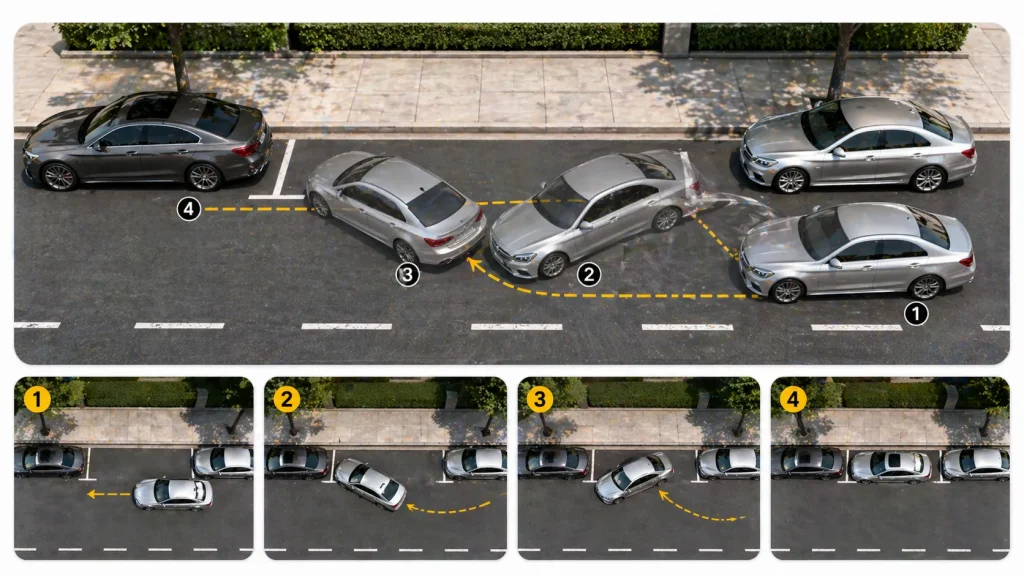
Step-by-Step Parallel Parking Technique
Step 1: Position Your Car
Stop beside the car parked in front of the empty space.
Keep about 2–3 feet distance between your car and the parked car. Your rear bumper should be close to the other car’s rear bumper.
Step 2: Reverse Slowly
Put the car in reverse and check:
Move slowly. Speed is the biggest reason beginners lose control.
Step 3: Turn Steering Fully
When your rear bumper lines up with the front car’s rear bumper, turn the steering wheel fully toward the curb.
Reverse slowly until your car reaches about a 45-degree angle.
Step 4: Align the Car
When your front bumper clears the front car, turn the steering wheel in the opposite direction.
This brings the front of your car into the space.
Step 5: Adjust & Straighten
Straighten the wheels and move slightly forward or backward until your car is:
- Parallel to the curb
- Centered in the space
- Not too close to other cars
- Around 6–12 inches from the curb
Parallel Parking Tips for Beginners
Parallel Parking Trick: The Easy 45-Degree Method
The easiest Parallel Parking trick is the 45-degree method.
How it works:
This method is beginner-friendly because it gives you a clear angle before entering the parking space.
Common Parallel Parking Mistakes
| Mistake | What Happens | Fix |
|---|---|---|
| Turning too early | Car hits curb | Wait until rear bumper aligns |
| Turning too late | Car stays too far out | Start turn earlier |
| Reversing too fast | Poor control | Move slowly |
| Not checking mirrors | Safety risk | Check mirrors + blind spots |
| Poor alignment | Crooked parking | Adjust forward/backward |
How to Practice Parallel Parking
Use an empty parking lot and place cones like parked cars.
Practice routine:
Parallel Parking Tips for Driving Test
For your driving test:
A small adjustment is usually better than forcing one perfect move.
Types of Parallel Parking Situations
Tight Spaces
Use slower speed and smaller steering corrections.
Wide Roads
Focus on staying close to the curb without blocking traffic.
Uphill Parking
Turn wheels away from the curb if required locally.
Downhill Parking
Turn wheels toward the curb for safety.
Small Car vs SUV Parallel Parking
| Vehicle Type | Parking Difficulty | Tip |
|---|---|---|
| Small Car | Easier | Turns quickly |
| Sedan | Medium | Use mirrors carefully |
| SUV | Harder | Allow more space |
| Manual Car | Medium | Control clutch slowly |
| Automatic Car | Easier | Use brake control |
Visual Positioning Guide
Starting position:
Your car should be beside the front parked car.
Turning angle:
Aim for a 45-degree angle before turning opposite.
Curb distance:
Final position should be about 6–12 inches from the curb.
Space rule:
You need enough room for your car length plus extra space front and back.
Trouble shooting Parallel Parking Problems
Car Not Fitting
You may have started too close or turned too late. Pull out and reset.
Too Far From Curb
Turn earlier toward the curb next time.
Hitting the Curb
You turned too sharply or reversed too far. Slow down and correct earlier.
Steering Confusion
Remember this simple rule:
- First turn: toward the curb
- Second turn: away from the curb
Parallel Parking Method Comparison
| Method | Difficulty | Accuracy | Best For |
|---|---|---|---|
| Traditional | Medium | High | Learners |
| 45° Trick | Easy | Medium | Beginners |
| Mirror Alignment | Easy | High | Driving test |
| Curb Reference | Medium | High | City parking |
Do’s & Don’ts
Do’s
Don’ts
1-Minute Learning Method
Use this simple memory trick:
Side → Reverse → Turn → Angle → Opposite → Straighten
This keeps the full process easy to remember during practice or a driving test.
Parallel Parking tips Near Me – Real World Tips
In crowded city areas, Parallel Parking Tips is harder because of traffic, pedestrians, and tight roadside spaces.
Use these real-world tips:
This connects real driving skill with everyday Parallel Parking Tips near me situations.
Parallel Parking Tips – FAQs
Final Insights for 2026
Modern cars now include parking sensors, backup cameras, AI parking assist, and self-parking systems. These tools help, but every driver should still learn manual parallel parking because sensors can fail, tests may require manual control, and real-world city parking still needs judgment.
Conclusion
Parallel Parking Tips becomes easy when you follow the right steps: position your car, reverse slowly, turn at the right angle, straighten, and adjust. The best approach for beginners is the 45-degree parallel parking technique because it is simple, repeatable, and practical for driving tests and city parking. Practice slowly, stay calm, and your confidence will improve quickly.